Blair Certified · Gallatin & Hendersonville, TN

Blair Upper Cervical
Chiropractor

Specialized in-office 3D X-rays. Precision atlas (C1) and axis (C2) correction.

The top two vertebrae sit at the base of the skull, surround the brainstem, and influence everything from posture and balance to chronic pain patterns. Dr. Palmer is Blair-certified and uses an individualized X-ray series customized to your unique anatomy — tailored to your specific anatomy.

Schedule First Visit Call (615) 219-9912
★★★★★ 5.0 from 94 patient reviews
The Blair Technique

A specialized form of upper cervical chiropractic.

Blair upper cervical is a chiropractic technique developed in the 1960s by Dr. William G. Blair. It focuses only on the top two vertebrae — the atlas (C1) and axis (C2) — because of their direct relationship to the brainstem, the cranial nerves, and the postural reflexes that govern the rest of the spine.

What sets Blair apart from other upper cervical techniques is the imaging. Each person's atlas-occiput joint is shaped slightly differently. A standard X-ray angle won't always show the true joint plane. Blair uses a pre-X-ray analysis to determine the exact angles needed to image your specific anatomy, then takes a customized series along those angles. The result is a much clearer picture of whether your atlas is misaligned, in which direction, and by how much.

The correction itself is low-force, hand-applied, and delivered with you lying on your side. There is no twisting, no popping, and no cracking. If your previous correction is still holding at a follow-up, we don't re-adjust — the body holds when the body holds.

Schedule First Visit
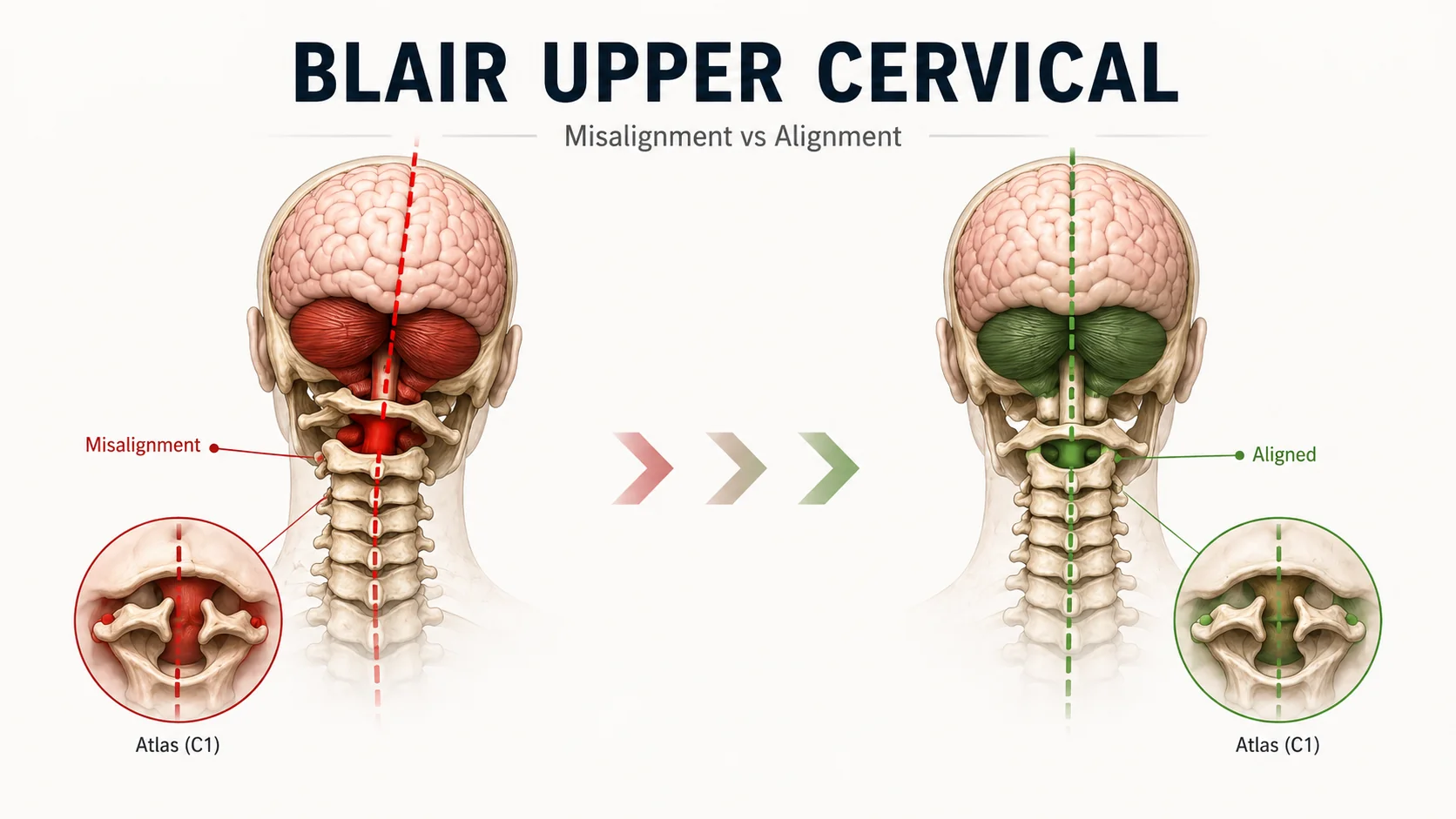

Blair Upper Cervical: atlas (C1) misalignment vs proper alignment, illustrated with cerebellum and brainstem context
Why Blair

What sets a Blair correction apart.

Most chiropractic care is full-spine and high-force. Blair upper cervical is built on a different premise: the most specific possible correction, only when imaging confirms a misalignment, and only with the least force needed.

01Imaging

Individualized X-ray angles

A pre-X-ray analysis determines the exact angles your specific atlas-occiput joint requires. The imaging is customized to your anatomy, not a standardized template.

02Force

Low-force, hand-applied

The Blair adjustment is delivered by hand in side-posture position, using the minimum force needed to make the correction. There is no twisting, popping, or high-velocity thrust to the neck.

03Hold checks

No adjustment if it's holding

At every follow-up we re-evaluate. If your previous correction is still in place, we do not adjust. The body holds when the body holds — no forcing the spine for the sake of it.

04Specificity

Only the atlas or axis

A Blair correction targets only C1 or C2. The rest of the spine often re-aligns on its own once the upper cervical is corrected, since posture is governed from the top down.

05Certification

Blair Society certified

Dr. Palmer completed Blair upper cervical certification through the Blair Upper Cervical Chiropractic Society — a formal training program covering imaging, analysis, and adjusting protocol.

06All ages

Infants to seniors

Because the force is so low and so specific, Blair is appropriate across the age spectrum, from infants with birth-trauma cervical involvement to seniors with degenerative changes.

Dr. Palmer Piana performing a side-posture Blair upper cervical adjustment on a patient
The Correction

Side-posture, hand-applied, no twisting.

A Blair correction is delivered with you lying comfortably on your side. Dr. Palmer's hands make a precise contact at the atlas or axis along the exact vector your X-rays identified, and the correction is complete in seconds.

Quiet, calm, and hand-applied. Just a calm, specific adjustment, followed by a brief rest period to let the body settle.

Who Blair Care Helps

Conditions commonly linked to upper cervical involvement.

Blair is not a treatment for any specific disease. The goal is to remove interference at the brainstem level so your body can function and heal more effectively. Patients seeking Blair care most often present with one or more of the following.

Chronic migraines & cervicogenic headaches
Headaches that originate at the base of the skull or that recur despite medication frequently have an atlas component. Many migraine patients see significant change once the upper cervical is corrected.
Vertigo & dizziness
The upper cervical spine has direct mechanoreceptor input into the brain's balance centers. Cervicogenic vertigo and Meniere's-type symptoms often track back to atlas misalignment.
Post-concussion syndrome
After a head injury, the upper cervical area absorbs significant force. Lingering brain fog, headaches, balance changes, and fatigue often improve when the C1/C2 alignment is restored.
Trigeminal neuralgia & facial pain
The trigeminal nerve has a direct anatomical relationship with the upper cervical spine. Persistent face, jaw, or tooth pain without dental cause is worth evaluating at the atlas level.
TMJ and jaw dysfunction
The atlas and the temporomandibular joint are anatomically and neurologically linked. Upper cervical correction often relieves chronic jaw clicking, locking, and pain.
Post-whiplash chronic neck pain
Lingering neck pain that never fully resolved after a car accident or injury frequently has an unaddressed upper cervical component. Specialized imaging can reveal what was missed.
Fibromyalgia & widespread pain
A subset of fibromyalgia patients have measurable upper cervical involvement contributing to their symptoms. Blair care is one of the few precise tools to address it.
Anxiety, sleep & autonomic complaints
The brainstem governs autonomic function — heart rate, sleep, digestion, stress response. Chronic upper cervical misalignment can manifest as autonomic dysregulation.
Our Approach

A new patient visit, step by step.

Blair upper cervical is structured. Each step has a purpose, and nothing happens by guess. Here's what a new patient visit looks like.

1
Detailed history & neurological exam
We map your symptom pattern, prior injuries (especially head and neck), and any neurological signs. Reflexes, balance, cranial nerve function — all of it informs whether the upper cervical is involved.
2
Pre-X-ray analysis
Before any imaging is taken, we measure your specific cranial geometry to determine the exact X-ray angles required for your individual joint anatomy. This is what makes Blair imaging different.
3
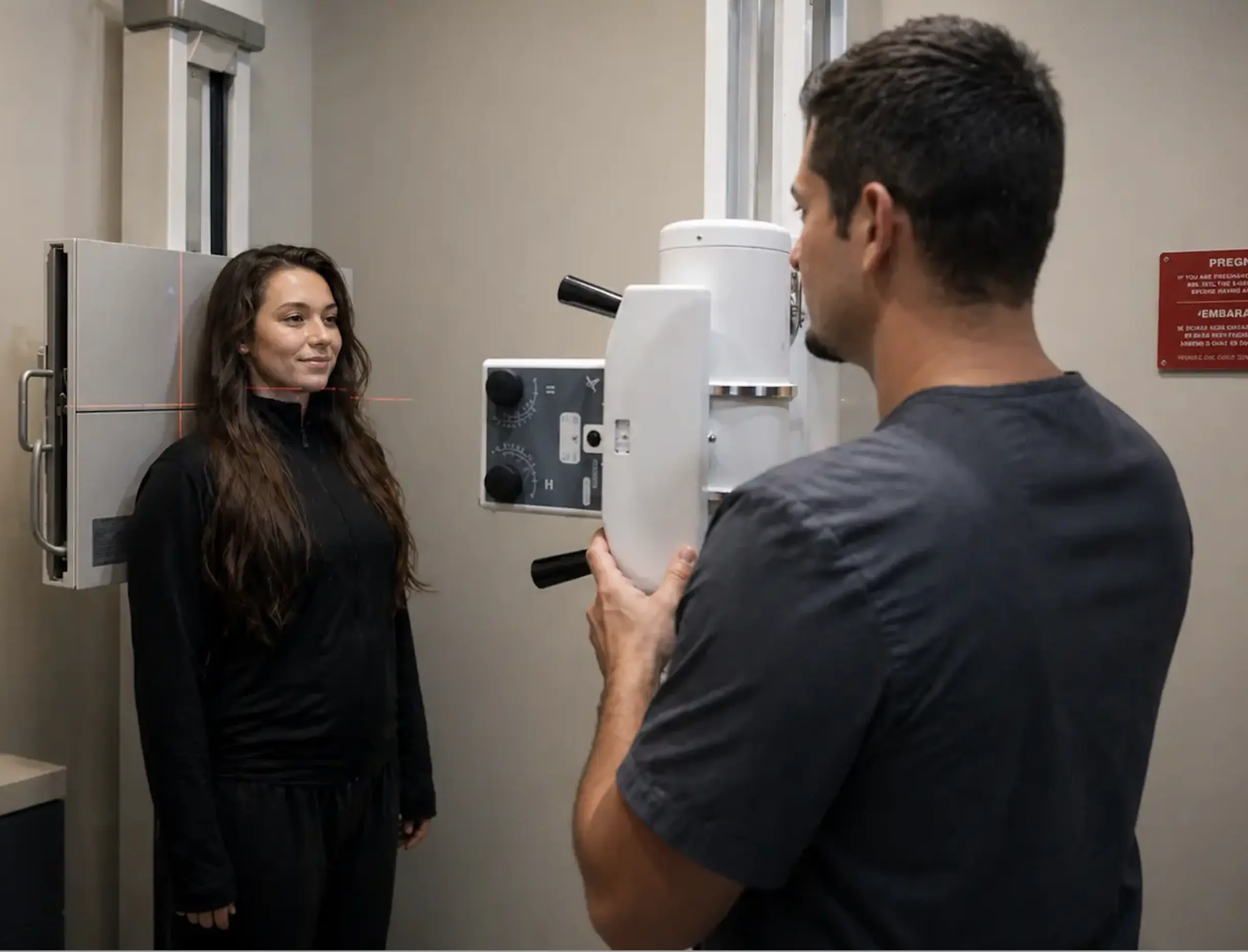
Specialized in-office X-rays
A customized series of cervical X-rays taken at the angles your anatomy requires. We see the atlas-occiput joint clearly and can measure the misalignment precisely, in three dimensions.
4
Report of findings
We sit down and show you the imaging, the analysis, and exactly what we found. You leave understanding what is happening, why it is happening, and what we plan to do about it.
5
Specific Blair correction
A low-force, hand-applied adjustment in side-posture position, calibrated to the vector identified on your X-rays. Quiet and hand-applied. Followed by a brief rest period.
6
Follow-up & hold checks
Subsequent visits are short. We check whether your correction is still holding. If it is, we do not adjust. If it has shifted, we re-correct. The body holds when the body holds.
Dr. Palmer Piana taking a specialized cervical X-ray at Life Charge Chiropractic in Gallatin TN
"The atlas is the most neurologically significant single bone in the human body. A small misalignment here can change posture, balance, and how the entire nervous system functions. That's why it deserves its own exam, its own imaging, and its own technique."
— Dr. Palmer Piana, Blair-Certified Upper Cervical Chiropractor
Frequently Asked Questions

Blair upper cervical FAQ.

What is Blair upper cervical chiropractic?
Blair upper cervical is a specialized chiropractic technique that focuses only on the top two vertebrae — the atlas (C1) and axis (C2). It uses individualized X-rays taken at angles unique to your anatomy, then a gentle, low-force, hand-applied adjustment to correct misalignment. Quiet, calm, and hand-applied. The technique was developed by Dr. William G. Blair in the 1960s and is one of the most precise upper cervical methods practiced today.
How is Blair different from regular chiropractic?
Most general chiropractic adjustments are full-spine and use a higher-force manual thrust. Blair upper cervical is the opposite: it only adjusts the atlas or axis, only when imaging shows a misalignment is present, and only with a precise low-force contact tailored to your individual joint angles. The goal is the most specific possible correction with the least force.
Why does Blair use specialized X-rays?
Each person's atlas-occiput joint is shaped slightly differently. Standard X-ray angles often miss the true joint plane in upper cervical patients. Blair uses a pre-X-ray analysis to determine the exact angles needed to image your specific joint geometry, then takes a customized series along those angles. The result is a much clearer picture of whether the atlas is misaligned, in which direction, and by how much.
Is Blair upper cervical safe?
Yes. Because the adjustment is low-force, hand-applied, and only delivered when imaging confirms a misalignment, Blair is one of the safest chiropractic approaches available. There is no twisting, no high-velocity manipulation, and no force applied if the previous correction is still holding. Patients of all ages, from infants to seniors, can be evaluated and adjusted.
What conditions does Blair upper cervical care help with?
Patients commonly seek Blair care for chronic migraines and cervicogenic headaches, vertigo and dizziness, post-concussion syndrome, trigeminal neuralgia, TMJ, fibromyalgia, post-whiplash chronic neck pain, and a range of conditions linked to brainstem and upper cervical function. It is not a treatment for any specific disease — the goal is to remove upper cervical interference so the body can function and heal more effectively.
Will I be adjusted at every visit?
No. Blair philosophy is that the adjustment holds when the body holds it. At every follow-up, we re-evaluate to see whether your previous correction is still in place. If it is holding, no adjustment is needed that visit. If it has shifted, we re-adjust. This is very different from a chiropractic model where every visit ends in an adjustment regardless of need.
How is Blair different from NUCCA or Atlas Orthogonal?
All three are upper cervical techniques. NUCCA and Atlas Orthogonal use a specific instrument or table-based contact along a calculated vector. Blair uses a hand-applied side-posture contact based on individualized X-ray angles. All three are precise, low-force, and effective when delivered by trained practitioners. The Blair approach is distinguished by its emphasis on imaging tailored to each patient's unique joint anatomy rather than a single standardized vector.

Serving upper cervical patients from Gallatin, Hendersonville, Goodlettsville, Portland, White House, Nashville and the broader Sumner County area.

Think the upper cervical spine might be involved?

Schedule a Blair upper cervical evaluation at Life Charge Chiropractic in Gallatin, TN. Specialized imaging, clear findings, no pressure.

Schedule First Visit
Call (615) 219-9912Schedule First Visit