Gallatin & Hendersonville, TN

Herniated Disc
Chiropractor

Life Charge Chiropractic helps patients in Gallatin and Hendersonville understand what a herniated disc actually means for their spine, their nerves, and their daily life, and what the right path forward looks like.

Schedule First Visit Call (615) 219-9912
A Real Look at the Disc

A herniated disc is mechanical, and most respond to specific care.

A herniated disc happens when the soft inner material of a spinal disc pushes through its outer wall and contacts, irritates, or compresses a nearby nerve. It is a structural problem, and most herniations are not random. They show up where the spine has been under uneven load for years.

At Life Charge Chiropractic, we look at which level is involved, which nerve root is irritated, how the surrounding spine is moving, and what the disc itself is doing under load. That picture, not the word herniation alone, is what guides care.

Most patients with a herniated disc are good candidates for conservative care. The question is whether the right care is being delivered to the right level, with the right approach.

Schedule First Visit

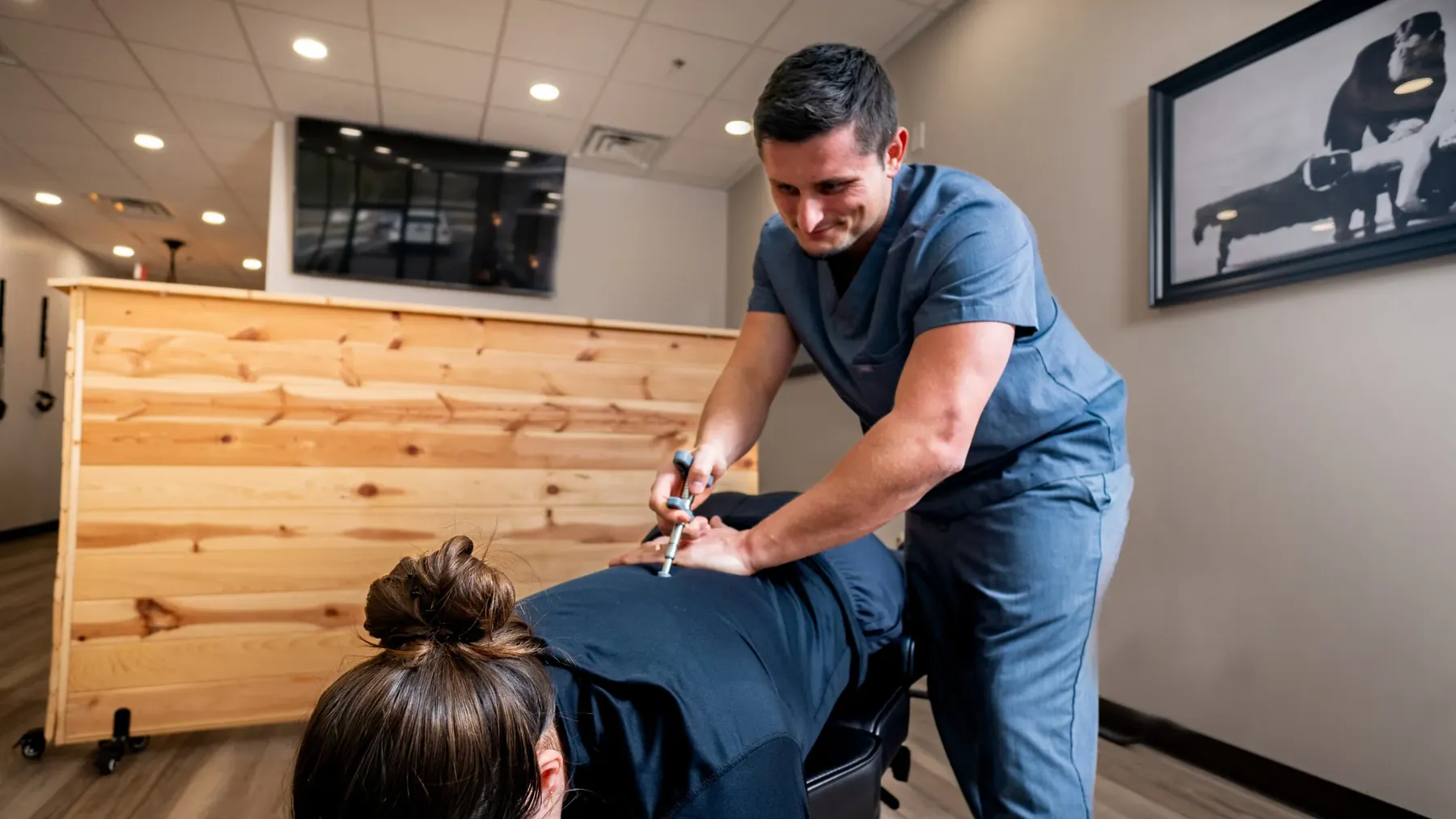
Dr. Palmer performing a focused lumbar adjustment
What Patients Describe

Common ways a herniated disc shows up.

Pain that travels into the leg
Sharp pain that runs from the low back into the glute, hamstring, calf, or foot is one of the most common patterns of a lumbar disc irritating a nerve root, often called sciatica.
Numbness or tingling
Pins and needles in a specific part of the foot, hand, or arm often map back to a single nerve root being compressed by disc material.
Weakness in a leg or arm
A foot that drops, a calf that gives out, or a grip that feels noticeably weaker is a sign the nerve signal is being interrupted and needs evaluation.
Pain with sitting, coughing, or sneezing
Disc pain almost always increases with anything that raises pressure on the disc, including prolonged sitting, bearing down, or a hard cough.
Sudden onset after lifting or twisting
Many disc injuries trace back to a single moment, lifting wrong, twisting under load, or a fall, even if there were warning signs for months.
Neck pain with arm symptoms
A cervical disc, often at C5/C6 or C6/C7, can cause neck pain that radiates into the shoulder, arm, or hand and needs the same careful evaluation as a lumbar disc.
Our Approach

Care that is specific to the level, the nerve, and the load.

A generic adjustment is not the right answer for a disc problem. We start with a careful exam so the care plan matches what is actually happening in the disc, the nerve, and the surrounding spine.

1
Detailed history and red-flag screen
We ask about onset, what makes it better and worse, bowel and bladder changes, saddle numbness, and progressive weakness, so anything that needs urgent care is identified first.
2
Neurological and orthopedic exam
Reflexes, dermatomes, muscle testing, and disc-specific orthopedic tests help us identify which nerve root is involved and how irritated it is.
3
Imaging when it changes the plan
We use digital X-rays to evaluate alignment and disc spacing. When the exam suggests significant nerve involvement, we coordinate MRI so the picture is complete before care escalates.
4
A care plan built around the disc
We choose adjusting style, decompression style work, and corrective exercises based on what your disc and nervous system can actually tolerate, and we adjust as you change.
Dr. Palmer adjusting a patient with a disc concern
"A herniated disc is a structural problem with a structural answer. The right care depends on the level, the nerve, and what the body is doing to compensate."
Dr. Palmer Piana, Life Charge Chiropractic
Beyond the Standard Exam

What we look for in a herniated disc exam.

A herniated disc is not one thing. The level, the size, the type, and the nerve involved all change what care should look like. These are the specific findings that drive the plan.

01Level

Which spinal level is involved

L4/L5 and L5/S1 are the most common lumbar levels, and C5/C6 is the most common cervical level. The exam pinpoints which disc is the source so adjusting and home care are aimed correctly.

02Nerve

Nerve root mapping

Pain pattern, reflex changes, and muscle weakness map to specific nerve roots. An L5 nerve root reads very differently from an S1, and that distinction shapes care.

03Severity

Bulge, protrusion, or extrusion

Disc problems exist on a spectrum. A bulge, a protrusion, and a true extrusion are not the same thing, and the difference matters for what care can reasonably accomplish.

04Red Flags

Cauda equina screen

Saddle numbness, loss of bowel or bladder control, and rapidly progressive weakness need urgent imaging and surgical consultation. We screen for these on day one.

05Imaging

MRI vs X-ray decision

X-ray shows alignment, disc spacing, and structural issues. MRI shows the disc material itself. We use the right tool at the right time so imaging is purposeful, not routine.

06Candidacy

Conservative care candidacy

Most disc patients are good candidates for conservative chiropractic care. We confirm that with the exam and rule out the cases that need a different first step.

07Technique

Decompression vs traditional adjusting

Some discs do best with low-force decompression style work. Others respond well to specific manual adjusting. We choose based on what the exam shows, and we change technique as the disc changes.

08Recovery

Post-care exercise plan

A disc that is calming down still needs the spine around it to learn a better movement pattern. We prescribe specific corrective work so the gains hold long after care ends.

Dr. Palmer reviewing disc imaging with a patient
What the Research Actually Shows

Most herniated discs do not require surgery.

When most people hear the words herniated disc, they think surgery. That association is understandable, and it is also outdated. Decades of research now show that the majority of herniated discs improve with conservative care, and that disc material itself often resorbs over time as the body breaks it down and clears it.

That does not mean every disc problem will resolve on its own. It means the body is built to handle this, and the right mechanical care can support that process rather than fight it. Specific adjusting, decompression style work, and targeted corrective exercise change how load travels through the disc, which gives the disc and the irritated nerve a chance to settle.

There are real cases where surgery is the right call. Progressive weakness, signs of cauda equina, and severe pain that is not responding to anything need surgical evaluation, and we coordinate that when the exam points to it. The far more common case is the patient who has been told they need surgery for a disc that would respond to specific care, if they had access to it.

The danger is not surgery itself. It is waiting too long with a nerve root that is being compressed, hoping it will go away, and losing function that does not come back as easily. The right move is a careful exam early, so you know what you are working with.

Common Questions

Herniated disc chiropractic FAQ.

Can chiropractic help a herniated disc?
Often, yes. Most herniated discs are good candidates for conservative care. The right care depends on the level, the size and type of herniation, the specific nerve involved, and how your body is responding. We confirm the picture with imaging when needed and tailor the adjusting style to what the disc can tolerate.
Will I need surgery?
In most cases, no. Surgery becomes the right call when there is progressive weakness, signs of cauda equina, or severe pain that is not responding to a real course of conservative care. The majority of patients we see for disc concerns improve without surgery when care is specific to the level and the nerve involved.
How is a herniated disc diagnosed?
Diagnosis combines history, neurological exam, orthopedic testing, and imaging. X-rays show alignment and disc spacing. MRI shows the disc material itself and is the gold standard when there is significant nerve involvement. We coordinate MRI when the exam points to it, rather than ordering it routinely.
Does it hurt to be adjusted with a herniated disc?
Care is matched to what the disc can tolerate. In acute or highly irritated cases, we use lower-force, decompression style techniques that do not involve the dramatic motion most people associate with adjusting. As the disc calms, the approach can change. Care is adjusted to your tolerance, never the other way around.
How long does recovery take?
Most disc patients notice meaningful change in the first few weeks of care. Lasting recovery, where the disc, the nerve, and the surrounding spine are all in a better place, usually takes longer. Dr. Palmer will give you a clear timeline at the report of findings, based on what your specific exam shows.
When is surgery actually needed?
Surgery is appropriate for cauda equina syndrome, progressive neurological deficit, severe weakness, and disc problems that have failed a real course of conservative care. We screen for these on day one and coordinate with surgical providers when the exam shows that is the right next step.

Worried about a herniated disc?

Schedule a new patient exam at Life Charge Chiropractic in Gallatin, TN. Same-week appointments available.

Schedule First Visit
Call (615) 219-9912Schedule First Visit