Gallatin & Hendersonville, TN

Neck Pain
Chiropractor

Chiropractic care for neck pain, stiffness, tension, and posture-related discomfort. We start with a clear look at what is actually going on.

Schedule First Visit Call (615) 219-9912
Why It Keeps Coming Back

Neck pain is not always just a neck problem.

Neck pain is often connected to more than tight muscles. Posture, spinal mechanics, upper back tension, stress, and nervous system irritation can all play a role. At Life Charge Chiropractic, we start with a detailed evaluation so we can understand what may be driving the problem before recommending care.

Posture patterns, spinal alignment, nervous system stress, and how your upper back and shoulders are functioning all play a role. Treating only the symptom, without understanding what is driving it, is often why neck pain keeps returning.

At Life Charge Chiropractic, we evaluate the whole picture before recommending a plan. That means a focused chiropractic exam, and when clinically appropriate, digital X-rays and thermal imaging to give us a clearer view of what your spine and nervous system are doing.

Schedule First Visit

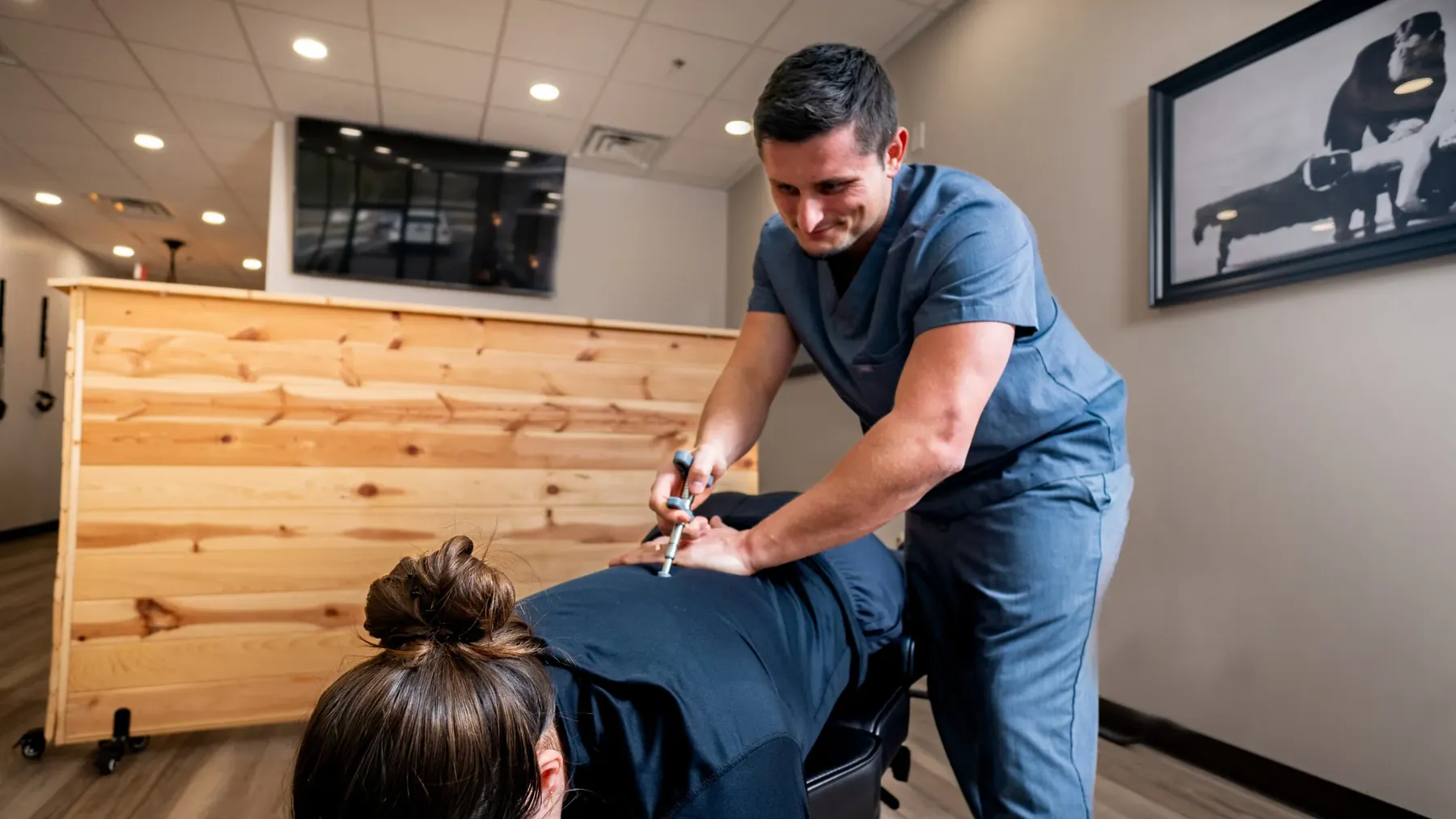
Dr. Palmer adjusting neck
Common Presentations

What patients describe when they come in.

Stiffness in the morning
Waking up with a neck that feels locked or hard to turn is a sign the joints and surrounding structures need attention.
Tension headaches
Headaches that start at the base of the skull and work forward are often connected to neck posture and upper cervical function.
Pain after screen time
Neck and upper back tension that builds through the workday is often posture-related and worth evaluating structurally.
Limited range of motion
Difficulty turning your head fully to one side, or pain when you do, suggests a mechanical issue worth examining.
Arm tingling or numbness
Nerve-related symptoms traveling into the arm or hand often trace back to the cervical spine and need a careful evaluation.
Recurring soreness
Neck pain that improves temporarily but keeps returning suggests the root cause has not been fully identified or addressed.
Our Approach

A clearer picture before a single recommendation.

We do not guess. Before any care is recommended, Dr. Palmer performs a focused evaluation designed to understand what is actually happening in your spine and nervous system.

1
Detailed health history
We listen to your symptoms, how long they have been present, what makes them better or worse, and what you have already tried.
2
Focused cervical exam
Range of motion, postural assessment, neurological screening, and hands-on spinal evaluation to understand the mechanics involved.
3
Digital X-rays when appropriate
X-rays help us evaluate spinal alignment, curve shape, and structural positioning so care can be specific rather than general.
4
Clear report of findings
Dr. Palmer walks you through everything found and explains what it means, so you understand the problem and the plan before care begins.
X-ray review room at Life Charge Chiropractic
"Pain matters, but pain does not always tell the full story. We look deeper to understand what may be driving the problem, not just where the symptoms are showing up."
Dr. Palmer Piana, Life Charge Chiropractic
Beyond the Standard Exam

What we look for in a neck exam.

Neck pain rarely lives in the muscle alone. It usually traces to the structure, the joints, and the nerves that move through them. These are the specific things we evaluate before recommending care, so the plan matches what is actually driving the pain.

01Curve

Loss of cervical curve

A flattened or reversed neck curve increases load on the discs and joints with every movement. We measure the curve angle on a standing lateral X-ray and track it over the course of care.

02Spine

Upper cervical (C1/C2) function

The atlas (C1) and axis (C2) carry a disproportionate amount of nervous system traffic. Subtle misalignment here often shows up as headaches, jaw tension, brain fog, or dizziness, not just neck pain.

03Posture

Forward head posture

Every inch the head sits forward of its neutral position adds roughly ten pounds of perceived weight to the cervical spine. We measure forward head posture on standing posture analysis and check what it has done to the curve below it.

04Discs

Cervical disc loading

Pain that worsens with looking down at a phone or laptop, or that radiates into the shoulder or arm, often points to disc involvement at the lower neck. We test disc loading with specific orthopedic maneuvers.

05Nerve

Nerve root irritation

Numbness, tingling, weakness, or pain into the shoulder, elbow, or hand often maps to a specific cervical nerve root. A careful neurological exam tells us which level is involved and how to focus the care.

06Headaches

Cervicogenic headache pattern

Many headaches that feel like tension or migraine actually originate at the upper cervical spine. We test for the referral pattern directly and treat the source rather than chasing the symptom with medication.

07Range

Range of motion restrictions

A neck that cannot turn fully to one side, or that feels stuck looking up, is telling you something about how the joints are functioning. We measure rotation, flexion, extension, and side bending in degrees and track them as care progresses.

08Tissue

Soft tissue and trigger points

Chronically tight upper traps, levator scapulae, and suboccipital muscles are usually responding to a deeper structural problem. We document where the tissue is reactive and address what is asking it to stay tight.

Dr. Palmer reviewing cervical imaging with a patient
A Connected System

Your neck does not work alone.

The neck is the most movable part of the spine and the most vulnerable to long-term postural stress. It carries the head, supports the eyes, houses the upper part of the spinal cord, and connects directly to the muscles of the jaw, the shoulders, and the upper back. Almost everything you do in a day passes through it.

When the neck stops moving well, the rest of the body adapts. The shoulders round forward. The mid back stiffens to compensate. The jaw clenches. The base of the skull tightens, and headaches start. By the time the pain shows up, the pattern has often been building for years.

Whole-system care looks at where the pain is loudest and where it is actually coming from. Sometimes those are the same place. Often they are not. A focused exam and, when needed, digital imaging give us the picture we need to make the care plan specific to your structure.

Specific care is what changes a chronic pattern. Generic care, the kind that adjusts the same handful of joints regardless of what was found, is also why so many patients tell us their previous chiropractic care helped for a day and then wore off.

Common Questions

Neck pain chiropractic FAQ.

Is it safe to have my neck adjusted?
Yes, when the right exam has been done first. We screen for the small number of conditions where adjusting the neck is not appropriate, and we use the technique that fits your structure, your tolerance, and the findings. Some patients are best served by gentle, low-force upper cervical work rather than a traditional manual adjustment.
How many visits will it take?
It depends on what the exam finds and how long the pattern has been there. Acute neck pain from a recent flare often responds quickly. Chronic neck pain with structural changes takes longer to correct. Dr. Palmer will give you a clear plan and expected timeline at the report of findings, so you know what you are committing to.
My neck pain is from working at a computer all day. Can chiropractic help?
Yes. Desk-related neck pain is one of the most common things we see. Care addresses what the posture has done to your structure and your nervous system, and we will give you specific corrective work and workstation adjustments that hold the gains between visits.
Why do I keep getting headaches with my neck pain?
A high percentage of headaches originate from the upper cervical spine. When the joints at C1 and C2 are not functioning well, the nerves that supply the back of the head, the temples, and even behind the eyes get irritated. Address the neck and the headaches often resolve as a direct consequence.
Do you offer gentler adjustment options for the neck?
Yes. Dr. Palmer is Blair Upper Cervical certified, which is a precise, low-force adjusting technique that uses specific imaging instead of manual neck rotation. It is a good fit for patients who are hesitant about traditional neck adjusting or whose findings call for that approach.
Should I see a chiropractor or a physical therapist?
Both can be helpful, often for different things. Chiropractic care focuses on the structural and neurological mechanics of the spine. Physical therapy focuses on muscular strength and movement patterns. We coordinate with PTs when the case calls for it, and we recommend specific corrective exercises for every patient as part of care.

Ready to find out what is driving your neck pain?

Schedule a new patient exam at Life Charge Chiropractic in Gallatin, TN. Same-week appointments available.

Schedule First Visit
Call (615) 219-9912Schedule First Visit