Hand Tingling After Fall Projects: Is It Your Wrist, Elbow, or Neck?
The location is a clue. The full story matters.

The wreath is almost finished. The last cabinet handle is tightened. Then you notice that two fingers feel fuzzy, or your hand has that familiar pins-and-needles sensation.
After a weekend of decorating, crafting, or gripping tools, it is easy to blame an overworked wrist. Sometimes the wrist is involved. But nerves can also become irritated near the elbow or where they leave the neck. And not every episode of hand tingling comes from a pinched nerve.
For adults in Gallatin and Hendersonville, the useful question is not “Which internet diagram matches my fingers?” It is “What should I notice, and how soon should I get this checked?”
Where you feel the tingling is a clue, not a diagnosis.
First, Know When Not to Wait
Call 911 for sudden unexplained numbness or weakness, especially on one side of the body, or for facial drooping, trouble speaking, new vision changes, sudden loss of balance, or a sudden severe headache. A stroke can begin during an ordinary activity. Do not assume a project caused the symptoms, do not drive yourself, and do not wait for them to pass. Even symptoms that disappear need immediate attention. [1]
Seek emergency care for numbness after a head, neck, or back injury, or numbness accompanied by inability to move a limb or new loss of bladder or bowel control. [2]
Three Places a Clinician May Look
Nerves carry sensation and movement signals between your nervous system and your hand. Symptoms felt in the fingers do not always identify where a nerve is being irritated. A clinician may need to examine the wrist, elbow, and neck together.
The Wrist: Often the Thumb-Side Fingers
Carpal tunnel syndrome involves pressure on the median nerve as it passes through the wrist. Tingling or numbness commonly affects the thumb, index finger, middle finger, and part of the ring finger. The little finger is not usually part of the classic pattern. Symptoms may wake you at night or show up while holding something with the wrist bent. [3]
A long stretch of using pliers, painting, or crafting may make symptoms noticeable. Repeated hand use and prolonged bent-wrist positions can aggravate pressure around this nerve. That does not mean one afternoon caused carpal tunnel syndrome, or that every thumb-side symptom is carpal tunnel.
The Elbow: Often the Ring and Little Fingers
The ulnar nerve passes behind the inner elbow, near the spot commonly called the funny bone. Pressure there, or keeping the elbow bent for a long time, can irritate it. This is called cubital tunnel syndrome when the nerve is compressed at the elbow. [4]
You might notice tingling in the little finger and the adjacent half of the ring finger after leaning on a workbench or keeping your arm folded while working. The elbow itself may ache, but much of the sensation can be in the hand.
That pattern still does not prove the elbow is the source. The ulnar nerve can also be compressed at the wrist, and neck problems can produce similar complaints.
The Neck: Symptoms That May Travel Down the Arm
Irritation of a nerve root in the neck is called cervical radiculopathy. It can cause arm pain, hand tingling, altered sensation, or weakness. Neck or shoulder-blade discomfort and symptoms that change with neck position may be useful clues. [5]
Tell the clinician if you noticed symptoms while looking up to hang decorations or looking down at detailed work. Do not deliberately repeat a painful position to “test” the nerve. A neck problem cannot be confirmed by a posture, a finger map, or a home maneuver alone.
The Pattern Is Only Part of the Story
Diabetes, thyroid problems, vitamin deficiencies, medication effects, and other conditions can also cause numbness or tingling. Symptoms in both hands, or in the hands and feet, deserve mention. More than one problem can coexist. [2]
The fact that tingling appeared after a project gives your clinician context. It does not establish the cause.
If It Is Mild and Brief, Pause the Project
If there are no warning signs and the sensation settles promptly when you change position, put the tool down and let the hand rest. Before returning to the task, consider what you can change:
- Reduce sustained gripping and alternate tasks instead of repeating the same motion for a long stretch.
- Keep the wrist in a comfortable, straighter position rather than bent sharply up or down.
- Avoid leaning on the inner elbow or keeping it tightly bent for prolonged periods.
- Move the project to a height that lets you work without holding your neck at an awkward angle.
These changes may reduce irritation; they do not tell you which nerve, if any, is involved. Do not push through increasing tingling, force stretches, or use repeated neck cracking as a home treatment. If your hand is numb or your grip feels unreliable, stop using sharp or powered tools. Reduced sensation makes accidental injury easier. [2–4]
A brace or exercise that helps one condition may not suit another. Ask for a recommendation based on an examination rather than choosing a treatment from the finger pattern alone.
Bring a Short Symptom Note, Not a Self-Diagnosis
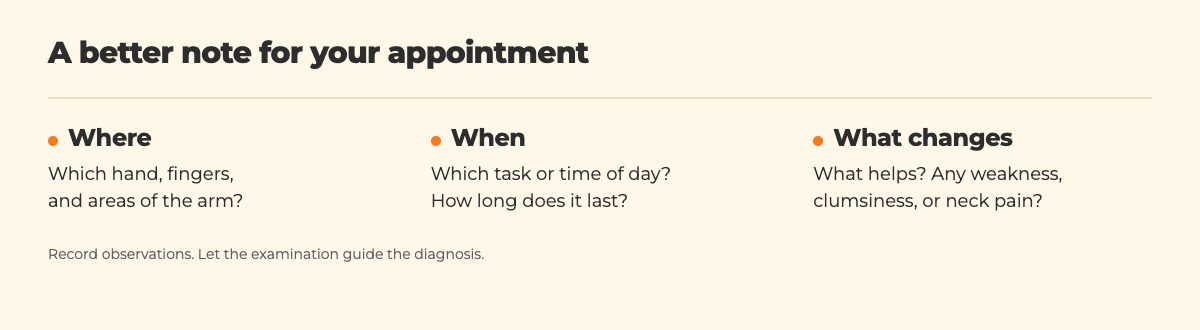
You do not need a detailed diary. A few notes on your phone can make the appointment more useful:
- Where: Which hand and fingers? Palm side, back of the hand, or both? Does it extend into the forearm?
- When: What were you doing? Does it wake you at night? How long does an episode last?
- What changes: Does stopping the task help? Is there neck pain, reduced grip, clumsiness, or difficulty fastening buttons?
A useful note might read: “Right ring and little fingers tingled while I rested my elbow on the table during crafting. It settled after I changed position, then returned that night.” That is an observation your clinician can work with, not a diagnosis.
Arrange an evaluation if tingling keeps returning, does not settle after you stop the task, wakes you repeatedly, or interferes with normal activities. You do not need to wait until it hurts. [2–4]
New or worsening weakness, repeated dropping of objects, or increasing hand clumsiness needs prompt medical assessment. Contact a medical clinician the same day for guidance rather than booking a distant routine appointment. Hand symptoms with new walking or balance problems need urgent assessment; if the change is sudden or severe, seek emergency care. These combinations can signal more than a local wrist or elbow problem. [1,2,6]
What a Good Evaluation Should Clarify
An examination begins with the history: when symptoms started, any injury, the tasks that bring them on, nighttime symptoms, medical conditions, and medicines. The clinician may check sensation, strength, reflexes, hand coordination, and movement through the neck and upper limb. [2–5]
Not everyone needs imaging. Depending on the findings, further evaluation might include nerve-conduction testing and electromyography, ultrasound, imaging, or blood tests. These answer different questions. An X-ray primarily shows bones; it does not by itself establish why a hand is tingling. Testing should follow the clinical question, not replace the examination. [2–5]
Ask: “What makes you think the problem is here? What else are you considering? What changes would mean I need a different kind of care?”
The right next step may be activity changes, a specific splint, rehabilitation, medical treatment, or referral to a hand or spine specialist. Chiropractic care is not the answer to every cause of hand numbness. Any proposed care should fit the findings, and progressing neurological symptoms should not be managed by simply continuing adjustments. Spinal cord compression, for example, is not a condition for neck manipulation. [6]
A Clearer Next Step in Gallatin
If hand tingling keeps interrupting your projects, sleep, or everyday routine, start with an evaluation rather than guessing at the source. For non-emergency concerns, Life Charge Chiropractic can discuss whether a chiropractic evaluation is an appropriate starting point or whether medical evaluation should come first.
We serve Gallatin, Hendersonville, and nearby Sumner County communities at 1921 Nashville Pike, Suite 500, Gallatin, TN 37066. Call (615) 219-9912 or contact Life Charge to discuss an appointment. For the warning signs above, seek medical or emergency care instead of waiting for a routine visit.
The project can wait. Getting a clearer picture of a recurring symptom is worth the pause.
Sources
- CDC: Signs and Symptoms of Stroke
- MedlinePlus: Numbness and Tingling
- AAOS OrthoInfo: Carpal Tunnel Syndrome
- AAOS OrthoInfo: Ulnar Nerve Entrapment at the Elbow
- AAOS OrthoInfo: Cervical Radiculopathy
- AAOS OrthoInfo: Cervical Spinal Cord Compression
This article is general education, not a diagnosis or a substitute for individual medical advice.
Schedule First Visit